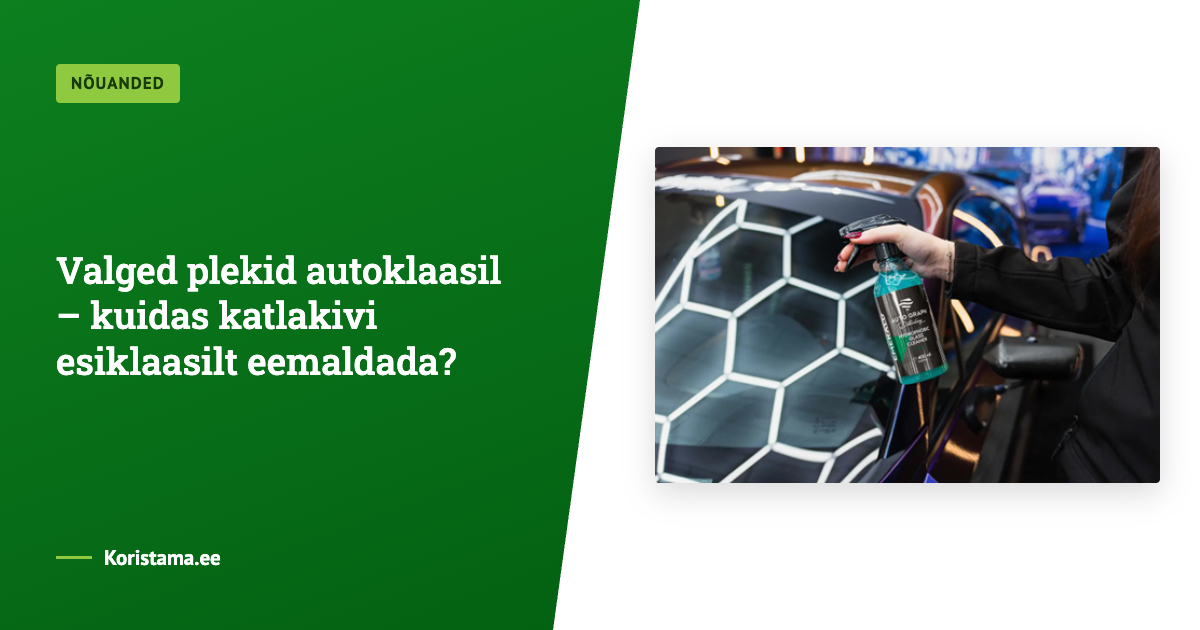
Optimal visibility is crucial for road safety. Even after a vehicle has been washed carefully, stubborn mineral deposits often remain on the glass. They are a direct result of hard water evaporating and leaving behind a residue that is hard to remove. The minerals crystallize on the surface, forming a hard crust. Many drivers underestimate this problem and unknowingly cause permanent surface deterioration and hazing of their glass. We explain how these deposits form and present proven methods for removing them effectively.
What Causes White Spots on Car Glass
Tap water contains a lot of calcium and magnesium, which becomes a problem when droplets left on the body dry in the sun or from engine heat. As the water evaporates, the minerals are deposited on the surface, forming the characteristic white spots on car glass, more specifically known as water spots. They are far harder than ordinary road contaminants, which is why regular washer fluid cannot dissolve such resistant crystalline structures.
Surface degradation intensifies at high temperatures, when sunlight bakes the mineral compounds in, leading to a loss of glass smoothness. Once a white film on car glass has bonded firmly to the surface, it permanently reduces clarity. Removing it then requires professional machine polishing with cerium oxide, which is why acting quickly helps you avoid such complex and costly restoration work.
The key to effective care is understanding the chemistry of mineral deposits: it means that pH-neutral shampoos remain ineffective. That is exactly why unsightly spots often appear on the windshield right after a visit to a touchless car wash, where the water is not always fully demineralized. Micro-droplets left on the surface evaporate almost instantly while driving, leaving persistent spots on the glass that are hard to remove with conventional methods.

What to Use to Remove Limescale from Car Windows
Effectively removing mineral deposits relies on the principle of chemical neutralization – because they are alkaline, acidic products are needed to dissolve them. However, it is important to use dedicated products that are completely safe for paint and rubber seals. Home remedies such as a vinegar solution should be avoided, as their aggressive action can cause rubber components to dry out and deteriorate.
Professional car care products such as TOURMALINE and ALEXANDRITE shampoos or CARNELIAN foam shampoo contain corrosion inhibitors that protect the paint. LAZURITE WATER SPOT REMOVER, on the other hand, is a product designed specifically for removing hard water spots. Its acidic pH instantly breaks down mineral bonds. It is a specialty product that works in seconds, dissolving deposits and restoring surface smoothness. LAZURITE also removes residue from other substances, restoring the hydrophobic properties of surfaces.
For lighter soiling, an acidic shampoo can help. ALEXANDRITE Organic Acid Shampoo helps remove mineral deposits as early as the pre-wash stage. It forms a dense foam and provides glide, minimizing the risk of scratches. Regular use of an acidic shampoo prevents limescale from building up. Where limescale on car glass is already heavily bonded and layered, a concentrated water spot remover (WSR) is required.
A well-chosen glass stain remover can also handle greasy road film. MALACHITE glass cleaner removes stubborn greasy contaminants in addition to mineral deposits. Its formula evaporates quickly without leaving streaks. It is a ready-to-use product, ideal for the final finishing of glass after demineralization. (Note: MALACHITE can handle fresh hard water deposits; without an acidic pH, it is not effective against old, heavily bonded deposits.)
Recommended products
- LAZURITE- water spot remover
- MALACHITE- GLASS CLEANER
- EMERALD – HYDROPHOBIC GLASS CLEANER
- Ceramic Quartz Gx glass
See all products: Car Glass. You can find the safety and product data sheets for every cleaning product on our safety data sheets page.
